

Jesus tells us to be “wise as serpents and innocent as doves” (Matthew 10:16). It takes an intentional sensitivity to read what is behind a person, a teaching, or a practice. Fortunately, the Bible does teach us some simple principles to activate our discernment. The Bible describes this as “testing the spirits” (1 John 4:1-3).
On another blog post, there is information for you about the importance of knowing your own strengths and weaknesses. This knowledge helps you be aware of your personal tendencies that may or may not match how God sees a situation (Isaiah 55:8-9).
Let’s define “spirit” as we consider this practice. You can think of spirit as the source or the motivation behind a person or philosophy. These motives may change over time. The intention may be for evil or for good.
As it pertains to people, some sample spirits may be jealousy, love, control, generosity, deception, or rebellion. Daniel was described as having an “excellent spirit” (Daniel 5:12, 6:3).
Likewise, a teacher or a philosophy has some source. The source may be from the soul (personal intention), the Holy Spirit, or the dark side (Matthew 8:33; Matthew 24:23-24; Mark 8:33; Ephesians 2:2; Ephesians 4:18-19; 1 Timothy 4:2; 1 John 4:3). Jesus said that the religious leaders of His time, the Pharisees, were actually spreading the lies of the devil (Matthew 23:13-33; John 8:44). Having a popular platform is not a guarantee that the motives, teachings, or practices of a person are in line with God and His Word (Matthew 7:21-23; 2 Corinthians 11:4).
Beloved, do not believe every spirit, but test the spirits to see whether they are from God, because many false prophets have gone out into the world. By this you know the Spirit of God: every spirit that confesses that Jesus Christ has come in the flesh is from God; and every spirit that does not confess Jesus is not from God; this is the [spirit] of the antichrist, of which you have heard that it is coming, and now it is already in the world. 1 John 4:1-3 NASB
Tests Explained

What is the purpose of a test? You can get a blood test to see whether you are healthy, anemic, pregnant, or carrying a pathogen. You take a test to prove you are capable of driving safely and are granted a license from the state. In psychology, I took a test to prove I had the knowledge of my field to earn a degree and (later) a license to practice. Likewise, when we recognize the need to test the spirits, there are a few simple principles that can guide us. Read the following guidelines to see what the Bible teaches us to test or discern teachers, philosophies, practices, or trends.
Detect False Teaching: What Do They Say About Jesus?
The passage from 1 John 4:1-3 is the primary test of whether a teaching, trend, or influencer comes from God. It’s very simple. If they are 100% clear that Jesus came from heaven, as God in human form, to pay for our sin, then that passes the first test.
If they redefine Jesus (2 Corinthians 11:4) as one way to God, as a prophet who taught about God, as an angel, as an inspired man, as an ascended master, or any other deviation, then they fail the test. They are not from God.
There are many places in the Bible that teach us about the absolute uniqueness of Jesus (because He is uniquely God in human form). Here are some of the unique aspects of Jesus.
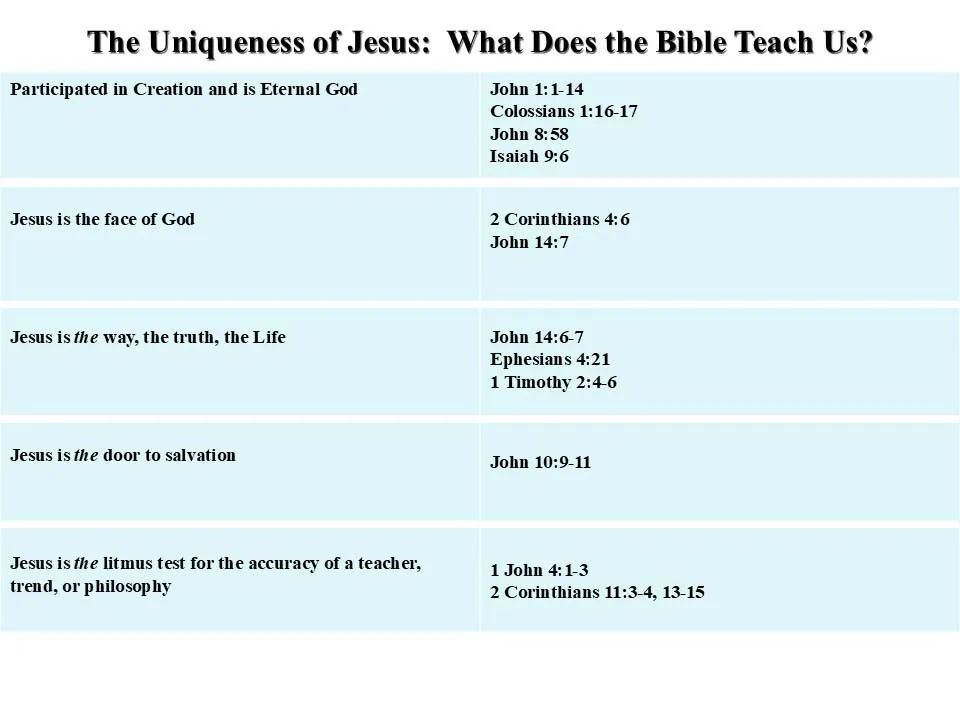
As you read the Bible and begin to get familiar with how Jesus describes Himself, you become empowered to detect false teaching, teachers, trends in the culture, and other types of deception. God wants you empowered to walk in freedom, truth, and peace!
Here is a link to another blog on spiritual discernment. On that page, you can also take a quiz to see how well your discernment is already developed.