

If you grew up in a dysfunctional family or have suffered some kind of trauma, then you may have difficulties with boundaries and self-care. You may struggle to find ways to set boundaries. You might get stuck in a passive role or as the perpetual caretaker for someone you love.
When you start to take care of yourself and begin to set limits, you might begin to feel guilty or selfish. This guilt is irrational. Healthy guilt is the result of breaking the law or a moral code. Irrational guilt comes from breaking a personal rule or taboo that probably originated from your family’s expectations or a fear of harsh punishment (or rejection). Resist the lie that you are being selfish. Replace it with the truth that:
- I am just taking care of myself. This is necessary if I want to be healthy.
- People who love me do not expect me to be their slave.
- If I don’t say what I mean, and stick to it, no one will take me seriously.
- It’s okay if sometimes people adjust to what I need.
- I am teaching others to be selfish when I always adjust to them.
A Balanced Style
To find balance it is important to identify your tendencies, recognize relationships that are out of balance, clarify a strategy for how to adjust frustrating interactions, and look at ways to be more authentic or assertive (as fits the situation). In this process we need to clarify our expectations and examine ways to set limits when others don’t respond to heathy communication.
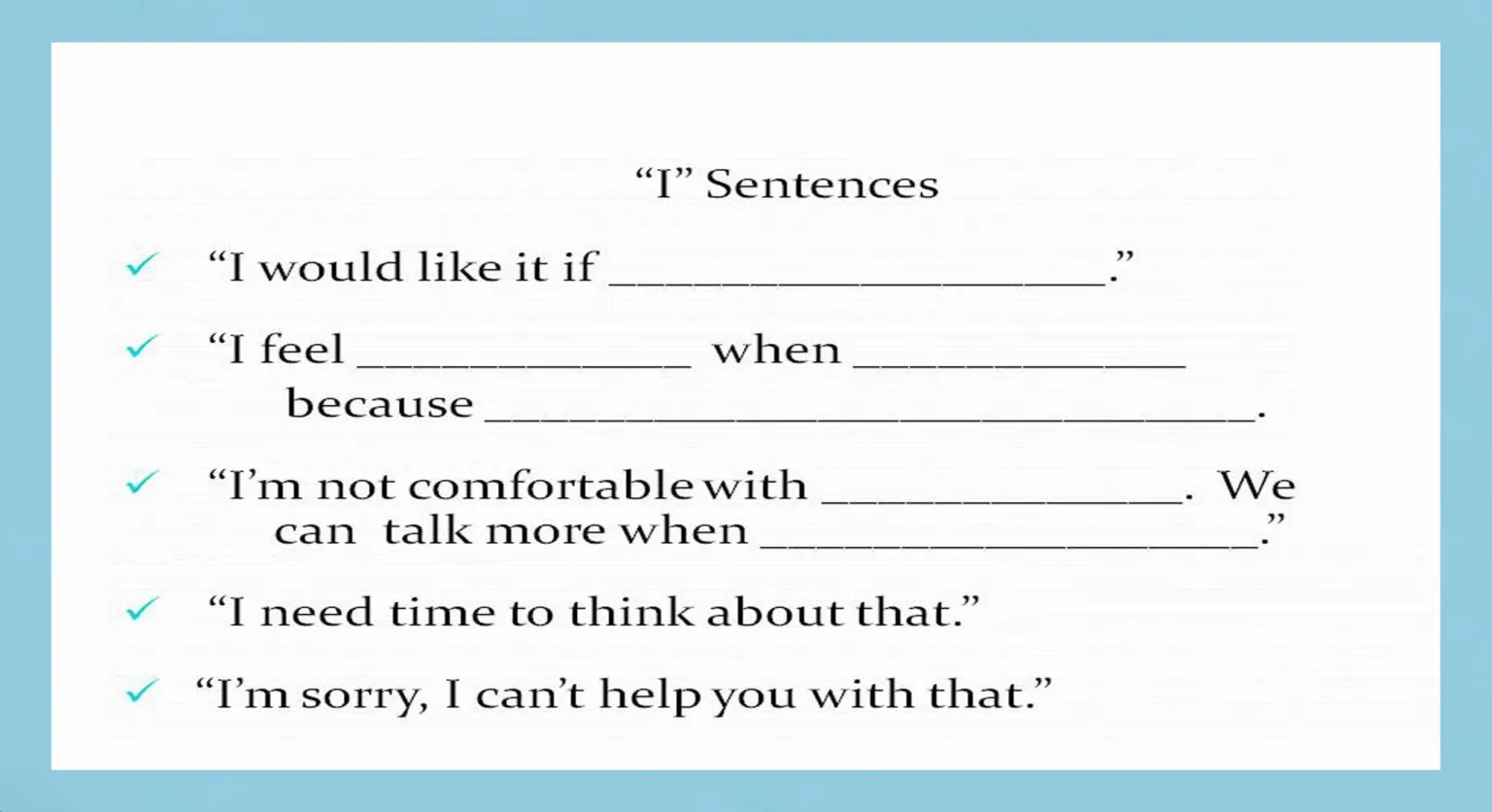
One of the easiest places to start is learning to use respectful “I” sentences to share your preferences and needs. This technique does not guarantee that your desires or needs will be met. Stating our requests gives the other person a chance to adjust the balance in the relationship with you.
Adults who are not moving towards health are likely to challenge or ignore your boundaries. If they refuse to respond to your requests in a meaningful way, then you know that you will need to clarify your expectations and level of emotional investment with that person.
Remember, we are talking about peer relationships with other adults. Relationships where you have responsibility to another person (such as in parenting or employment) do not fit the model I am describing to you. Some principles may be helpful, but we cannot treat every relationship like a friendship.
Communication and Boundaries
Perhaps you are familiar with the communication tool of “I” sentences. When we are using an “I” sentence, we express ourselves using the word “I” instead of you. This technique is a non-confrontational way to express our needs. It is not a guarantee that the other person will respond well, but it is a polite way to express our feelings and concerns.
It is much gentler to say, “I feel hurt when you don’t respond to my text” rather than asking, “Why are you ignoring me?” One statement invites a response. The other question is an accusation.
In ongoing frustrating situations, you may need to:
- Clarify the expectations for yourself and others. Are they realistic? Have you expressed them? What are your options if the other person refuses to move in your direction?
- Step back and leave more space in the relationship.
- Examine healthy ways to get some emotional needs met through other people.
Codependent Attachments and Relationship Addiction
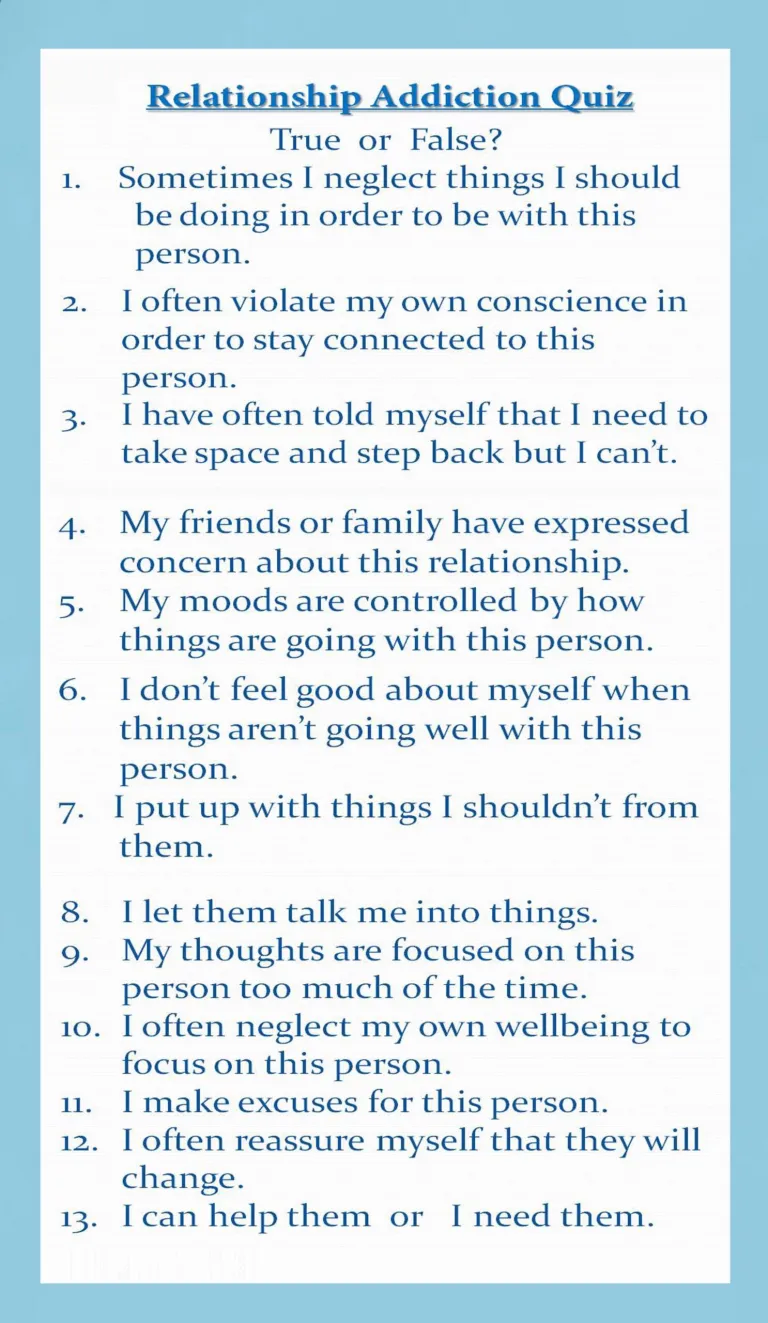
You may be familiar with the term “codependent” or relationship addiction. Essentially, when we are overly focused on caring for another person, changing another adult, or holding on to another person, we are probably in a problematic attachment.
These types of relationships frequently occur in romantic bonds or between an individual and their adult child. As we have discussed, we are not going to change another adult who demonstrates by their behavior that they are not interested in change. (Talk is cheap.) When we hold on to another adult at a level that is damaging to us, there is probably some level of control or some absence of self-care involved.
Printed above is a quiz on “Relationship Addiction” to help you examine any relationship where you have questions about your level of involvement (also called “Codependency”). These questions are adapted from the work of Patrick Carnes (2001).
There is no grade or diagnosis for this quiz. However, the more questions that you answer as “yes”, the more likely it is that you are connected in an unhealthy way to that person.
There are two main things to consider if you have an unhealthy tie with an adult. The first question to consider is whether you are holding on to the person because you are hoping to change them. You might want to check out my chapter on “Control” issues (or the video by the same name).
The second area to consider is the level of emotional dependence that you have with that other person. We are probably drawing too much of our sense of worth from that connection. We give away our power when we look to another person excessively for our sense of worth.
There may be a sense of grief or loss if you begin to slightly detach from a relationship where you have been overly involved. The chapter on “Building Self-Confidence” in the book may help. You can look at other groups, friendships, or hobbies to fill in the emotional space as you adjust your boundaries.
This blog is taken from my book, “Anxiety, Depression & Helplessness: Keys to Break Free.“
The quiz is adapted from the book by Patrick Carnes.
Carnes, P. (2001). Out of the Shadows: Understanding Sexual Addiction. Center City, Minnesota: Hazelden Publishing.