

Are you looking to make a change, but have trouble getting started? Or do you get started and then lose your motivation? Use this little acronym to help you start and then succeed in making lasting change to reach your goals.
Are You RIPE for Change?
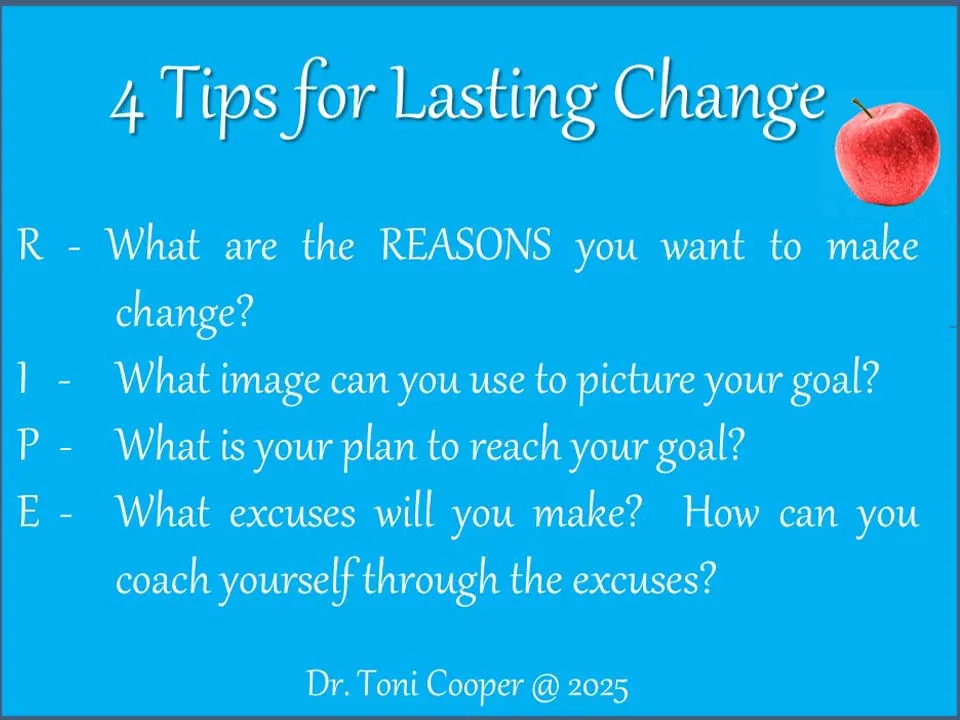
One of the ways that I help people think about reaching their goals is the acronym “RIPE.” I would encourage, as you consider each step, to put your thoughts into writing. Using a journal will help you firm up your resolve, and research indicates it’s a valuable step towards successful change!
R – What are your reasons for wanting change?
One of the first things you can do is write down 3 or 4 reasons that you have about why you want to make the change. Maybe your goal is to get in shape. The reasons might be: to feel better, to improve my health, to improve my energy level, or to feel more confident. Having your reasons written down will help you think through (and strengthen) your motivation.

I – Use an image to picture your desired goal
You know that a picture is worth 1,000 words. So, when you use an image related to your goal, you are using the strength of that picture to further shift your attitude toward your desired goal.
You might be motivated to improve your health so that you can have more energy for family and hobbies. Choosing an image of your family may be a good image to help you remember your reasons for making change (R).
When I want to get in shape, I can criticize myself for how I am now OR I can use a positive image. Self-criticism is not motivating but a positive image makes your goal attainable. In the past, I have selected an outfit I want to wear for an event, like a wedding, and I hang it up in my dressing area. That way, every time I look at it, I have a positive image to motivate me. Later, when I want my candy bar, I’ll remember that image and that I want to fit in that dress! Then I am more likely to stick to my plan. Choose an image that will help you remember your reasons (R).

P – What is my plan to reach my goal?
You need a plan for the baby steps you will take each day so that you are moving in your desired direction. (Maybe you have heard the saying, “He who aims at nothing is sure to hit it!”) You want to think about WHAT you are going to do, HOW OFTEN you are going to do it, HOW LONG you are going to spend on the activity, etc. These are the simple, practical steps that will help you make your desired change. Again, you want to write out this part of your plan.
Sticking with the example of getting in shape to improve my health, I may decide to start exercising as part of my plan. My plan might be to walk 4 days a week for 20 minutes from 8:00AM to 8:20 AM on Monday, Wednesday, Friday, and Saturday. The more specific and clear you are in your plan, the more likely you are to achieve that goal!
Many people use a support group, an accountability partner, a sponsor, or a workout buddy to provide the positive pressure to follow through on their plan. Most everyone does better when they are part of a team that will celebrate each step with you.

E – What excuses will I make to stall on taking the steps?
The last step in RIPE is to write down the excuses that you might make when it is time to take action. We all make excuses and that’s why we don’t meet our goals as often as we would like! If we are honest with ourselves, and give it some thought, we know what our most common excuses are. One of mine is: “One more day won’t matter.”
Once you identify your most common excuses, you want to develop some ways to coach yourself when you start to make that excuse. Again, it is the most powerful if you write down your new coaching statements to use to gently replace the excuses.
When I need to take action, and I say “One more day won’t matter,” I can coach myself. I can say, “Each day matters and I am taking one step today that will make me feel good about my progress.” Most the time that works. When I see a pastry I might have to remind myself of my image (I) and say “I’m going to go home and have some delicious grapes.” You want to replace your excuses with uplifting, supportive talk to yourself. Try to avoid using shame, self-criticism, or guilt when you talk to yourself. These painful emotions do not motivate!
A few other tips for lasting change
You might be tempted to try to make several big changes at once or to set really big steps as you develop your plan (P) for change. Most people do not make change that way! Small, reasonable steps that are folded into our daily routines are the most effective. Then as the small changes get established, you can build the next step.

Using our “getting in shape” example, the first step of the plan is 20 minutes of walking on 4 days of the week. When that habit is in place for several weeks, you might want to expand your time to 25 or 30 minutes.
Many people also keep track of their progress in their journal. Seeing your progress will help motivate you to stay with your plan.
An old proverb says that a journey of a thousand miles begins with a single step. Focus on the step for today. Try to find a group or a buddy that is going to support your efforts. You can succeed taking one step at a time!
More Resources:
If you want more help on changing negative thinking and developing more positive coping strategies, consider checking out one of my self-help books or audiobooks.