

We grow up and develop a view of ourselves, people, and God based on our experiences. We are shaped most deeply by our family experiences. Your family’s attitudes about love, trust, adequacy, and belonging form the core of your personality. Your family’s reactions to your mistakes and failures can create problems with toxic guilt. A harsh conscience will prevent you from living in the peace and freedom that Jesus wants you to enjoy (John 8:36). This article explains healthy guilt, toxic guilt, and God’s grace from a Biblical perspective.
Pit or Palace?
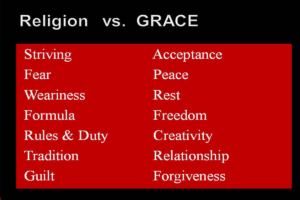
Early emotional experiences, of guilt and inadequacy, accumulate before we are old enough to understand God. We carry those childhood feelings, subconsciously, into our understanding of God. You can have very accurate intellectual beliefs about God in your head, but you may have trouble feeling the truth of those beliefs in your daily life. Emotional experiences with people, especially parents and religious leaders, impact our ability to enjoy God’s love and acceptance.
Our view of God can mentally put us in a pit or a palace. A harsh view of God places us in the basement, or pit, where you may feel like a guilty slave. You may have trouble forgiving yourself or putting the past behind you. The palace, our true position in Christ, is where we enjoy the constant love and blessings of God regardless of the quality of our performance. The Bible teaches us that we are beautiful children of the King (Psalm 45:10-11), seated in heavenly places (Ephesians 2:6), with our sins cast into the depths of the sea (Micah 7:19). Our sins are removed from us, as far as the east is from the west, according to the Lord (Psalm 103:12).
If I am carrying guilt, shame, or self-rejection then I am less likely to receive God’s forgiveness easily. I may even be trying to live the Christian life out of my own power. If so, I am focused on my religious activity rather than my secure relationship with Jesus. I am thinking like a slave and not as a favored child of God (John 1:12; Romans 8:14-15). If you think about the lives of Mary and Martha (Luke 10:38-42), Jesus actually commended Mary, who was sitting comfortably in His presence, while He gently corrected her sister, Martha. Martha, who was working hard in the kitchen to serve Jesus and her family, was missing the boat according to Jesus!
Religious Striving or the Rest of Faith?
Martha’s behavior to please Jesus might be considered as striving. Religious striving is when we work to earn God’s love and approval instead of peacefully accepting that approval that Jesus bought for us. An example of resting in our connection to God (rather than religious striving) is the establishment of the Sabbath. I joke with my clients that God took a Sabbath on the seventh day in His work of creation – and I’m sure He wasn’t tired (Genesis 2:2-3). Many people go to church to celebrate the Sabbath and stores used to be closed in respect for the day of rest. We are also invited, in a spiritual and emotional sense, to enter into God’s rest (Matthew 11:28-30). You see another picture of this spiritual and emotional rest in Psalm 23 where we learn about Jesus as the Good Shepherd.
In an interesting paradox, we are also told to enter into God’s rest (Hebrews 4:11), follow Jesus in the path of righteousness (Psalm 23:3), and take up our side of the yoke to learn from Jesus (Matthew 11:28-30). Jesus carries the heaviest part of the yoke as we build His kingdom with Him. You see there is a balance of practicing our faith each day within the framework of a peaceful, rather than a tense, state of mind.
Guilt or Grace?
There are some people who do not experience guilt. They have a damaged conscience. However, having an overly active conscience is not healthy either! You might be surprised to know that instead of delivering condemnation to the woman caught in adultery, Jesus said “Go and sin no more” (John 8:1-11). In Romans 8:1, we are told that there is no condemnation to those who belong to Jesus. In 1 John 1:9, we are taught that if we confess our sins, He is always ready to forgive us. Our sin is erased by the blood that Jesus shed on the cross (Isaiah 1:18; Isaiah 53:5-6). There are many worship songs about the power of the blood of Jesus to cleanse every stain from sin!
Chronic guilt is the sign of an overly active conscience. Generally, an overly active conscience is the result of too many early experiences, with parents or other authority figures, of criticism or harsh punishment without sufficient praise and affection. If you struggle with living under the law, you are still being defined by those early experiences. Jesus wants you to be free from guilt and religious pressure through His resurrection power and grace (Romans 8:1; Hebrews 10:17-22).
You can see how it’s easy to get stuck in a view of God that is based on OUR performance instead of HIS payment. It’s also hard to maintain joy or peace if you are approaching God with an attitude of fear that requires you to constantly perform perfectly to earn His love. If you grew up trying to prove your worth, struggled to earn love and approval, had a sibling who was the favorite, or if you received frequent punishment without a lot of affection, then you may find it especially difficult to change your thinking. You may find it a challenge to receive God’s forgiveness and, even more so, to forgive yourself. (People who received a lot of affection rarely struggle with accepting God’s love, forgiveness, and grace when they have failed.)
if you think about it, the religious people in the Bible who were big on rules and short on love and compassion were the Pharisees. They attacked and argued with Jesus. Jesus confronted them about their pride and spiritual blindness. When our faith is driven by the need to earn God’s approval, we have lost our understanding of grace. We don’t see the incredible completeness of the payment Jesus made with His own life in exchange for our punishment (Galatians 4:7, 9; Galatians 5:4-5). We are stuck in a view of God that is too much like the Pharisees!
Harsh Religious Experiences Create Toxic Guilt
Belief systems that encourage passive acceptance of suffering, abuse, or injustice as “God’s will” are not consistent with the teachings of the Bible. These types of teachings often occur in religious movements that encourage blind acceptance of leaders. The Bible teaches that leaders should look out for the needs of their flocks (Ezekiel 34:1-10; John 13:1-17). The New Testament teaches that men are designed to be the protectors, leaders, and nurturers of their wife and children (Ephesians 5:25-29; Ephesians 6:4).
If you were raised in a church that had distorted teaching about leadership and submission, you may feel guilty when you think for yourself. God designed you with a brain and gives you the Holy Spirit so you can balance other people in their blind spots (Galatians 6:1; Hebrews 10:22-24).
Jesus Releases Us from Guilt and Offers His Friendship
The Bible teaches that Jesus suffered and died to make a way for us to be close to God. This should take the pressure off of us! Jesus calls you His friend (John 15:15)! He also invites us to approach Him boldly (Hebrews 4:15-16). If it is hard for me to rest in God’s presence, approach Him boldly, or receive His forgiveness when I fail, then I am living under the law and not in the grace that Jesus wants to lavish on us (Ephesians 1:7-8). I am probably relying on my own righteousness instead of the righteousness of Jesus (Ephesians 1:7; Ephesians 2:6-9; Galatians 3:1-3). This forgiveness and freedom, based on the blood sacrifice of Jesus, sounds too good to be true. But this is what the Bible teaches us.
When we look at the teachings of Jesus, He addressed various misconceptions about guilt. Remember, He said, “My yoke is easy and My burden is light” in Matthew 11:30. He is the perfect balance of truth and mercy (John 1:17). Jesus teaches us in word pictures to help us shift our view of God and correct our distortions from bad experiences with people. Here are some of the pictures Jesus gives us of God’s care:
- a shepherd and the sheep (John 10:1-18),
- a mother hen and her young (Luke 13:34),.
- a friendship (John 15:12-17), and
- a tree and its branches in a vineyard (John 15:1-11).
Each of these pictures demonstrates the protection, provision, and tender bond that God offers His followers. Sheep, chickens, friends, or branches do not earn their place. The Shepherd cares for the sheep at the sacrifice of His own life. The mother hen gathers her young and keeps them under her protective watch. A friend shares secrets and plans (John 15:15, Psalm 25:14). A tree automatically provides the nurture for each branch. Jesus wants us to see that He is the initiator and the source for our relationship.
It’s hard for us to grasp the truth that we do not earn our place with God from day to day. But the Bible teaches us that God understands our weaknesses and gives us a fresh start each day (Lamentations 3:21-24).
Releasing Guilt
We should feel some guilt when we violate our conscience. However, when we have apologized to God or to the person we have hurt, that guilt should go away. If you have trouble releasing guilt, remember that:
- Chronic guilt does not come from God.
- A harsh conscience comes from overly strict parenting or toxic teaching from legalistic churches.
- Dealing with the source of the toxic guilt, from our experiences with people, is an important way to shift from guilt to grace.
- Changing the way you talk to yourself is a good way to shift out of guilt into the truth.
A Prayer to Shift from Guilt to Grace
First, you want to be sure that you have given your life and your sin to Jesus. Here is a simple prayer to do that:
Lord Jesus, I acknowledge that You are God who voluntarily died to pay for my sin (John 10:18). You had no sin but You paid for all of mine. I want to be clean and free from sin. I ask You to be my Savior. I yield my life to You from now on. Fill my heart and mind with Your truth. Teach me how to live in a healthy way that pleases You. Thank You for Your gift of salvation to me. Please fill me with Your Spirit to understand you better (1 Corinthians 2:11-12). Amen.
Next, you want to release the experiences from your past that create toxic guilt. Here are some insights from the life of Lazarus to show us how to release that toxic guilt. In John 11:34-45, Jesus raised his friend, Lazarus, from the grave. But after Lazarus was raised from the dead, he still had burial cloths tightly wrapped around his hands and feet and covering his face! Jesus said to them, “Unwrap him and let him loose” (John 11:44).
If you have asked Jesus to be your savior, then you have forgiveness for sin: past, present, and future. But, like Lazarus, we all have coverings (distortions and false beliefs) over our eyes that need to be removed. As the distortions are removed, we can live with greater peace, joy, and vision of God’s love.
You can use this prayer to cleanse yourself from assumptions or vows you may have made (consciously or subconsciously) that distort your vision and enjoyment of God’s love. Often, people don’t recognize these attitudes until they read them out loud. (You might even want to say this prayer out loud.)
In the NAME of JESUS, I come out of agreement with the LIES that: I am not good enough; I am not worthy of love; or that I do not belong. I choose to forgive those people who hurt me, by accident or on purpose, where I learned these attitudes.
In the NAME of JESUS I renounce any VOWS I might have made that: I will not trust; I will not feel; or that I will never allow myself to be hurt again.
Thank You, Lord, that You set me free from wrong beliefs and harmful vows. Help me, from now on, to fill my heart and mind with Your truth.
Help me to replace these old attitudes of toxic guilt and shame with Your truth as I read the Bible. Amen.
Resources to Shift from Guilt to Grace
 Many of the books I have written help people untangle from unhealthy guilt and a harsh conscience. (There is also more on this subject in my blog on self-criticism.)
The information in this article are excerpts taken from my book, “Correcting Distortions in Your View of God: How to Unload Baggage that Blocks Your Vision.” You can purchase this book through Amazon, or from Booksby (which offers free shipping).